

A Path to $30/hr. by 2030
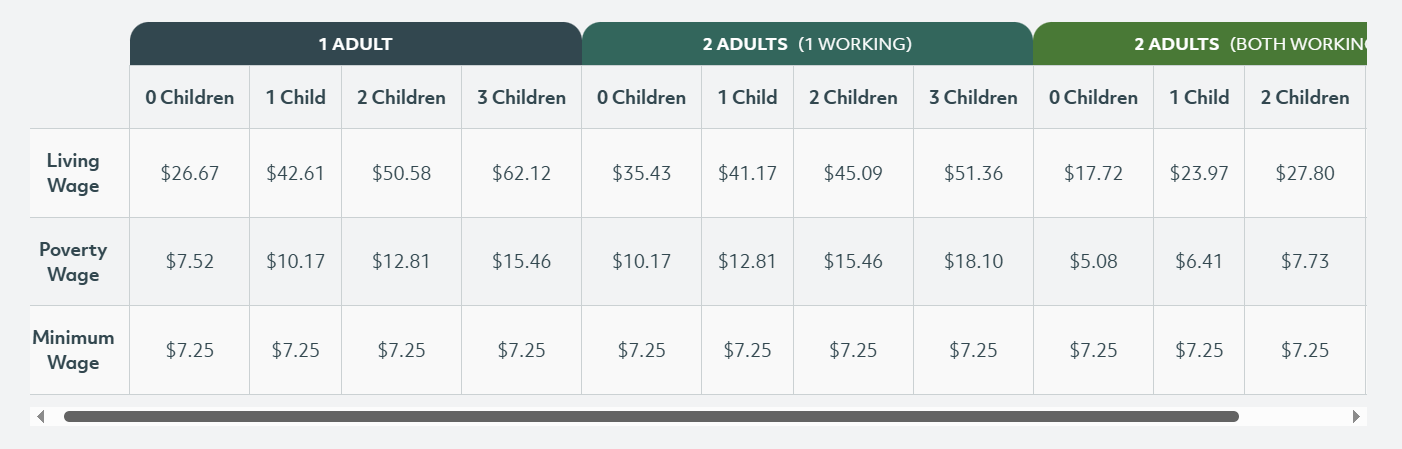
Click the link to be taken to MIT’s Living Wage Calculator and see why I landed on $30, data based on Union County, NC or you can select the county where you live. https://livingwage.mit.edu/counties/37179
Worker and Main-Street friendly.
First - let’s define a living wage. Which is the hourly rate that an individual in a household must earn to support themselves and/or their family, working full-time or 2080 hours per year. The tables created by MIT research (above) provide living wage estimates for individuals and households with one or two working adults and zero to three children. In households with two working adults, all hourly values reflect what one working adult requires to earn to meet their families’ basic needs, assuming the other adult also earns the same.
Second - let’s define the American Dream. As a millennial (born in 1985), I grew up thinking that each generation in the U.S. had a higher standard of living than the previous, signs of shared growth in American productivity. The prevailing idea was that you could support and raise a family from a single income, the father goes to work to provide enough to pay the bills and put food on the table. Well the thought and reality of attaining said dream has drastically changed in my lifetime. Research shows that working a full-time job at the current minimum wage would not allow you to live in any U.S. state. Isn’t that a bit wild? I understand that no one is likely to stay at a minimum wage forever, but if an 18 year old that just graduated wants to branch out close to home - that’s financially not even possible.
There’s nothing wrong with working hard but most working class families are having to work three or four jobs between full-time and part, just to keep up with rising cost of living. When families are pinching every penny they are unable to contribute as much to the local community - less visiting a local coffee shop or restaurant, less likely to purchase new goods or services for the home from local service providers, essentially shrinking the size of the local economy. So this is why it makes sense to take bold action, moving away from minimum ($7.25) and tipped minimum ($2.13) and transitioning to $30 an hour by the year 2030.
$30 an hour sounds like a lot at first but amounts to $62,400 a year before taxes and falls closer to $45,000 after taxes. As the data above shows, if wages kept up with productivity, the minimum wage would have been ($18.42) by 2014. The following is a plan that forces large employers to lift pay quickly, protects truly small businesses, and pays for the transition by taxing extraordinary corporate profits and ultra-high personal incomes, just as the U.S. did in the 1950s. Workers get a dated, guaranteed path to $30 by 2030 nationwide. Small businesses keep their doors open with a permanent subsidy so neighborhood diners and repair shops aren’t collateral damage.
How it helps + How we get there.
More paying customers: When millions of workers move from $12 to $18 or from $20 to $30 an hour, cash registers ring at more places. People have disposable income to spend at diners, auto shops, hardware stores, on childcare, etc.
Less turnover + higher skill: Better wages cut turnover and absenteeism. Training sticks better with years of service so mistakes fall. These are direct cost savings that rarely show up on a P&L sheet.
Fewer junk costs: Families current on rent and utilities generate fewer collection losses for landlords and power co-ops. Hospitals eat fewer bills and local governments collect steadier taxes without hiking rates.
Real competition again: When all employers live under the same wage floor, the game shifts to who can run the best shop to retain the best employees.
1) Wage based on employer size
If we want higher wages, we need a few things. One is a federal wage floor and second a funded transition that helps small and mid-sized employers bridge the gap. Paid for by taxing extreme profits from ultra-wealthy corporations (think Top 100 each year) and excessive income from billionaires, not by squeezing workers or Main Street. Large corporations that have captured windfall profits shoulder the burden as they did in the 1950s instead of treating low wages as a business model. The end goal is a universal $30/hour floor by 2030, with larger firms moving first and small businesses getting breathing room and full support. Tipped & sub-minimum wages would be phased out on the same schedule.
Employer size 2026 27 28 29 2030
≥500 emp. $20 $24 $27 $29 $30
100–499 $18 $22 $26 $28 $30
20–99 $16 $20 $24 $27 $30
<20 (micro) $16 $19 $22 $26 $30
2) Small business Promise
For employers with fewer than 20 employees, which is over 90% of businesses in the US, the federal government fully subsidizes the wage delta through revenue generated by taxing the wealthy individuals and corporations mentioned earlier. The difference between a worker’s current rate and the required floor each year would be subsidized as a refundable payroll credit. How it works automatically via quarterly payroll filings:
Credit = Required wage − Base wage × hours (capped at 2,080/yr). Deposited in near-real time against payroll tax with any excess refunded. No eligibility for firms splitting to dodge the 20-employee line and no credit for owners’ own pay above $150,000 will serve as guardrails.
3) How to Pay For It
Corporate income tax with a 70% top bracket and 21% → 28% base rate for C-corps. Progressive tax brackets on domestic profits above large thresholds, culminating in a top corporate rate of 70%.
1950-style top personal rates for ultra wealthy incomes that reinstates high marginal brackets, 70%–90% marginal rates above $50 to $100M in annual taxable income.
Billionaire Minimum Income Tax. Close the step-up loophole.
Excess-profits 10% surtax on current pre-tax profits above 125% of firms’ 2018–2019 inflation-adjusted average which are the “normal profits” benchmark pre-Covid. This prevents price gouging.
Buyback & distribution brakes which raise the buyback excise from 1% to 4%. No buybacks or special dividends for firms that fail to hit the wage schedule and violations trigger loss of deductions or penalty surtax.
4) Anti-avoidance Crackdown
Headcount and profits are calculated across commonly controlled entities where parent or corporate subsidiaries, sister companies, and P/E rollup. Splitting a firm to duck a bracket triggers joint liability and a 3× penalty. Large multinationals compute the wage floor on U.S. payroll and the tax brackets on U.S.-sourced profits. CEO-pay link where firms with a CEO to median pay ratio greater than > 20:1 lose access to accelerated depreciation and certain credits until compliant.
5) Inflation & Small business protections.
Fund DOJ/FTC to police price gouging in concentrated sectors like food, shipping, healthcare supply, etc. Procurement standards where federal and state buyers require compliance with the wage schedule and neutrality in organizing rewards transparent and progressive employers. Startup safety protection where new firms or those <3 years old and <20 employees get automatic micro-business credits with simplified filing. Rural support could also serve as an option, providing micro-grants for rural Main Street (under $2M receipts) to cover non-wage transition costs.
6) Why Not Keep the Old System?
The old model which provides poverty or near-poverty wages looks cheap on payroll but expensive everywhere else. Customers who can’t afford the very goods and services local businesses sell. Public systems quietly subsidizing low wages while mega-corporations book record buybacks. Main Street has been footing this bill for far too long.
This wage reform can fundamentally rebuild the working class in America. The revenue package to pay for the subsidy [70% top corporate bracket, modern excess-profits tax, high-end personal brackets, buyback excise] is designed to exceed peak costs, leaving room to fund public-sector wage catch-ups (teachers, nurses, EMTs) and IRS enforcement to keep the playing field honest. We can build public dashboards to show prices by sector, and enforcement actions so the public can see who’s playing fairly. This is a move for the people, not the corporations who think that they are one.