

Healthcare is a Birthright.
It’s time for the United States to join the civilized world and treat healthcare not as a profit engine, but as a sacred right. While you ponder that yourself, consider these interesting facts.
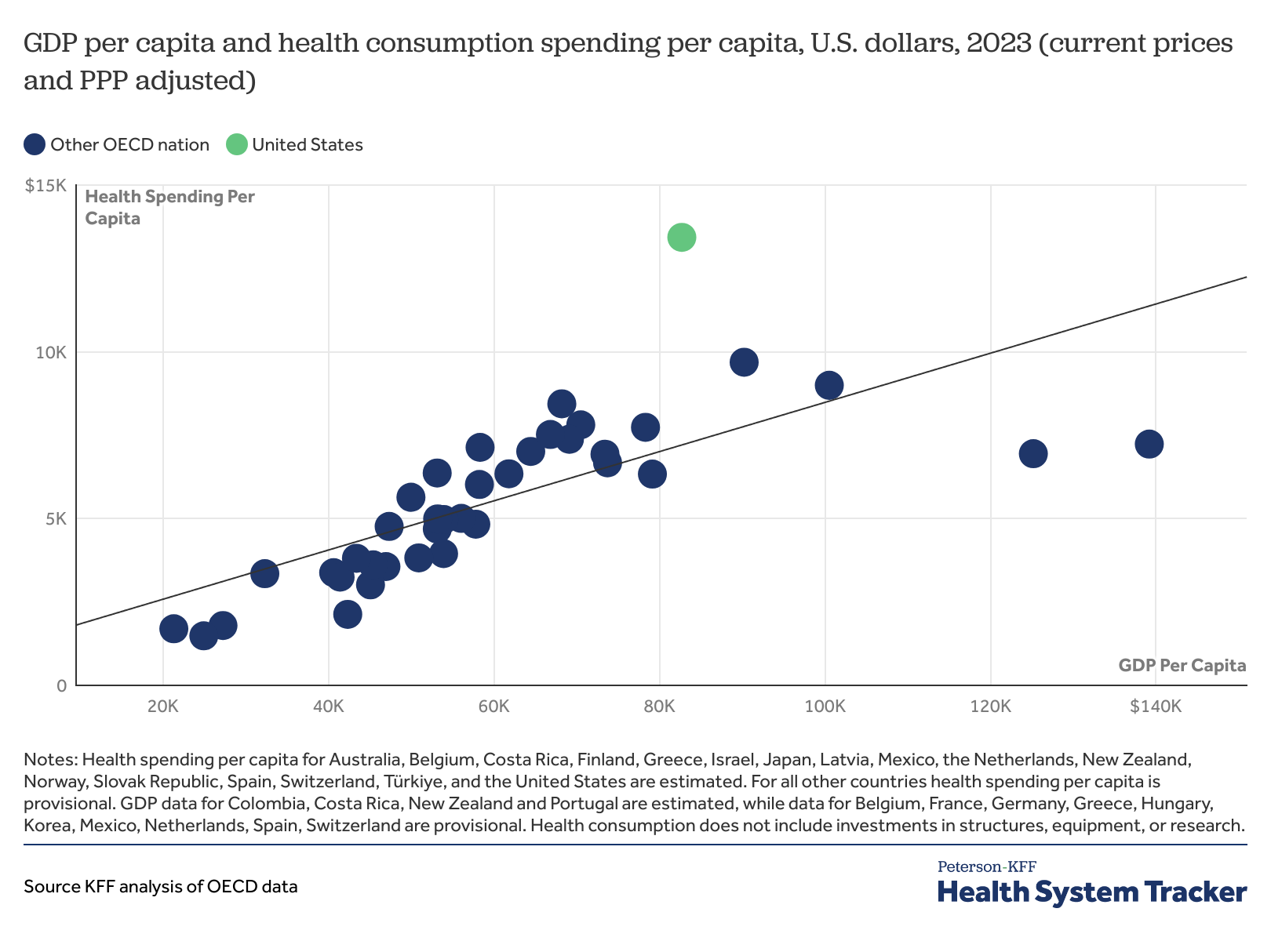
We spend near 2X as much per person on healthcare as the next closest country yet rank 49th in life expectancy. Sounds like a raw deal to me.
The U.S. ranks #1 in medical debt + #1 in preventable deaths + #1 in maternal mortality among developed nations. Being numero uno here in no beuno.
Over 66% of all personal bankruptcies in the U.S. are due to medical bills, something that is literally nonexistent in countries with public healthcare systems.
The U.S. spends more than any other country on the planet, yet ranks nearly 50th in global life expectancy. Why are Americans dying younger than citizens in nations with fewer resources, how is this possible? It’s because our healthcare system prioritizes profits over people / margins over outcomes. While other developed countries treat healthcare as a public good, the U.S. treats it as a private commodity that is sold, rationed, and monetized. We’ve traded compassion for quarterly earnings and allowed Wall Street to determine who gets to live with dignity and who dies in debt. Life expectancy data as of 2024, show a 6 to 10 year gap exists between the U.S. and our closest allies and competitors with a universal healthcare system. How can one argue with a better system, savings of taxpayer money, and extended life spans?

We’re Paying More, Living Less
Leave it to the U.S. healthcare industry to find a way to make it about profits. As a large portion of today’s costs comes from paperwork, billing games, and middlemen and not actual care. Moving to a universal healthcare system could save the U.S. taxpayer money each and every year while covering every single person young and old. Current cost estimates for universal healthcare in the U.S. near $3.5 to $4T. This is a significant amount but when compared to the $4.5T we currently spend, the opportunity to save close to $500B every year arises. To put that in context, the cost to make all colleges and universities tuition free is $450B every year. Think about that for a second, we could essentially fund free universal healthcare and education with taxpayer funds - now that is a country that I would want to live in.
With a Medicare-for-All system the federal government would serve as the main payer - setting fair transparent prices and replacing premiums, deductibles, and surprise bills with a predictable way to pay. That shift will especially helps families dealing with chronic or terminal conditions, often hit hardest by out-of-pocket costs. It also helps the economy as employers wouldn’t have to offer health benefits just to hire people. Workers gain newfound freedom and wouldn’t be stuck in jobs for the health insurance. Companies could focus on building long-term products and paying fair wages instead of juggling new benefit plans and price hikes. If we judge a society by how it treats those who need help most, then a health system built around care, not profit incentives, gets us closer to that standard.
How The World Passed Us By
Most developed nations built universal healthcare in two big waves. The first after World War II, when governments treated health care as core social infrastructure alongside pensions and education. A second wave arrived from the late 1980s through the 2000s as countries standardized coverage and closed healthcare gaps.
The UK launched the NHS in 1948. France expanded Sécurité Sociale from 1945 toward near-universal coverage. Nordics built out tax-funded or social-insurance systems through the 1950s–70s. Japan reached universal coverage by 1961 through nationwide enrollment in employer and community plans. Canada went province by province with nationwide adoption by the early 1970s. Australia established Medibank in 1975, and New Zealand’s universal model traces back to the 1938 Social Security Act.

South Korea unified its insurance funds to reach universal coverage by 1989. Taiwan implemented single-payer national health insurance in 1995. Israel’s National Health Insurance Law took effect in 1995. Switzerland in 1996 and the Netherlands in 2006 mandated universal enrollment in tightly regulated, non-profit–like insurance markets. Many systems continued to refine toward near-universal statutory coverage by the 2000s.
So most of the developed world moved to universal coverage in the mid-20th century, then modernized and closed remaining gaps by the 2000s. The U.S. by contrast doubled down on private insurance and prescription medicine. Medicare and Medicaid were introduced in the 1960s but were limited patches versus comprehensive reform. In our country the rise of health insurance conglomerates, pharmaceutical monopolies, and hospital chains turned illness into a business model.
Countries without Universal Healthcare Coverage
These countries do not provide universal healthcare, meaning not all citizens have guaranteed access to essential health services without financial hardship:
Afghanistan
Bangladesh
Cambodia
Haiti
Indonesia
Laos
Myanmar
Nepal
Nigeria
Pakistan (not fully covered nationwide)
Papua New Guinea
Somalia
Sudan
Syria
United States (varied coverage, not universal)
Yemen

Only the United States and New Zealand permit widespread direct-to-consumer (DTC) advertising for prescription drugs, a practice banned in most other countries due to safety concerns
What Other Countries Got Right & What We Got Wrong
United Kingdom (NHS): Universal care funded by taxes. No bills or insurance companies and life expectancy is 82.6 years. Insurance Gatekeepers. America’s private insurers determine what treatments are ‘medically necessary’ based on profit margins and not patient needs. Denials, delays, and restrictive networks are ways to increase profits.
Japan: Public insurance for all with private providers. Regulated low costs and life expectancy is 85.2 years nearly 5 years longer than the U.S. Profits or Death. The average CEO of a top U.S. health insurer earns over $20 million per year while tens of millions of Americans remain uninsured or underinsured. Hospital mergers have created regional monopolies that are allowing systems to charge 10x Medicare rates for routine procedures.
France: Hybrid system with universal access and 90% satisfaction rates and life expectancy is 82.5 years. Pharmaceutical Monopolies. Americans pay up to 10 times more for the same medications compared to Canadians or Europeans. Insulin costs $6 to produce but sells for $300 per vial in the U.S. due to patent gaming and middlemen.
Germany: Non-profit insurers offer universal coverage and admin costs are half that of the U.S. Administrative Waste. Nearly 30% of U.S. healthcare spending goes to billing and paperwork versus actual care. No other country comes close.
How America Can Catch Up
Medicare for All (Universal Healthcare or Single-Payer System) Replace private insurance with a public system that covers all Americans from birth to death. Invest in prevention and public health by shifting spending from reactive care to prevention, nutrition, mental health, and chronic disease management. Eliminate co-pays, deductibles, and surprise bills that are funded through progressive taxation. Outlaw medical bankruptcy and guarantee that no American goes broke due to illness. Cap out-of-pocket costs and ensure universal access to treatment. Empower Medicare to negotiate prices and ban anti-competitive practices that inflate drug costs. These moves among others saves money by removing profit margins and administrative waste.
America’s obsession with privatized healthcare has produced a system that is morally indefensible and economically unsustainable. No one should have to choose between treatment and bankruptcy, or watch loved ones suffer because a corporation denied coverage. If health is wealth, then universal care is the foundation for a truly prosperous nation. We have the resources and the public support. What we lack is the political courage.
