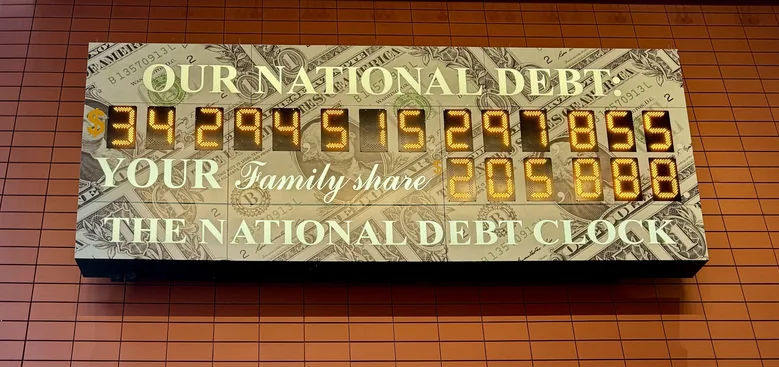
Corporate Welfare & National Debt




Combined these top 20 industries claim $250 B in subsidized rebates, tax incentives, loopholes, grants, contracts, etc. Some want to point the finger and shame those that rely on a form of government assistance such as SNAP or low-income housing - yet when you look at if from a bird’s eye view, the true mass of government assistance goes to Corporate America. Call it what you want, a subsidy is in the same type of category as a social handout considered by some as unethical redistribution of wealth.
Top 20 U.S. subsidized corporate industries
1. Utilities & power generation ≈ $40 B
Good Jobs First shows utilities and power generation getting about $39–40 billion in disclosed subsidies. Top corporate recipients: American Electric Power (AEP) >$1.5 B in subsidies. Duke Energy, Exelon, AES, Clearway Energy each in the $1B-class range when you combine megadeals, tax abatements, and federal energy programs.
2. Motor vehicles ≈ $39 B
Motor vehicles is one of the single largest categories at about $39.4 billion in tracked subsidies. Top recipients: Ford Motor about $8.0 B. General Motors about $7.8 B. Tesla received large state/local packages for Gigafactories plus federal EV/energy credits in the hundreds of millions. Foreign automakers like Toyota, Volkswagen, BMW, Hyundai/Kia, also receive multi-hundred-million state “megadeals” for U.S. plants.
3. Aerospace & military contracting ≈ $25 B
Good Jobs First aggregates ~$25 billion for aerospace and military contracting. Top recipients: Boeing has the single biggest subsidized company in the database, with about $15.6 B in subsidies across nearly 1,000 awards. Lockheed Martin, RTX, Northrop Grumman, General Dynamics each with large state packages plus federal loan/tax-credit support that totals in the billions.
4. Oil & gas ≈ $21–22 B
Good Jobs First’s oil and gas category totals about $21.5 B in direct state/local plus some federal development subsidies. Separate research counting tax breaks and underpricing of externalities pushes U.S. fossil-fuel support into the tens to hundreds of billions per year, depending on methodology. Top corporate recipients: Venture Global LNG >$4.3 B mainly Louisiana megadeals. Valero Energy >$1.1 B plus ~$0.3 B of federal loan support. ExxonMobil about $1.96 B in state/local subsidies plus $5.35 B in federal loans/guarantees. Chevron, BP, ConocoPhillips each with hundreds of millions in property-tax abatements, credits and federal finance support.

5. Retailing (big-box, e-commerce) ≈ $19.4 B
Top recipients: Amazon.com is the second-largest subsidized corporation overall, ~$14.4 B, mostly in property-tax abatements, infrastructure subsidies, and cash grants for warehouses and data centers. Walmart has several billion in local abatements and tax-increment financing over decades. Home Depot, Target, and major mall developers like Pyramid Companies ≈$974 M also feature prominently.
6. Chemicals ≈ $14.9 B
Top recipients: Dow Inc. – >$1.0 B. Air Products & Chemicals have multiple megadeals and tax-exempt bond packages totaling hundreds of millions. Nova Chemicals, CF Industries, and other petrochemical/fertilizer firms round out the top tier.
7. Diversified conglomerates ≈ $14.4 B
“Diversified” covers multi-sector conglomerates, top recipients: Conglomerates controlled by Mubadala, Aditya Birla Group, and other multi-line industrial/chemical/metal holding companies, with many overlapping megadeals in metals, chemicals and manufacturing.
8. Financial services ≈ $13.3 B + giant bailouts
Good Jobs First’s financial services bucket totals about $13.3 B in explicit subsidies. But the huge story is bailouts, the same dataset shows multi-trillion-dollar face values for crisis lending and guarantees during 2008–09 and COVID. Top recipients: JPMorgan Chase about $1.75 B in direct subsidies plus $1.34 trillion in federal loans/guarantees. Bank of America ≈ $0.8 B direct, plus an eye-popping $3.6 trillion in loan/guarantee support. U.S. Bancorp tens of millions in direct awards, >$40 B in federal loan/guarantee support.
9. Metals ≈ $10.2 B
The metals industry has about $10.2 B in disclosed subsidies. Top recipients: Alcoa around $5.7 B, making it one of the most subsidized companies in the country. Nucor, U.S. Steel, ArcelorMittal have sizeable property-tax abatements, grants, and infrastructure deals for mills.
10. Freight & logistics (trucking, parcel, warehousing) ≈ $10.2 B
Subsidy Tracker breaks freight and logistics out separately (e.g., FedEx, UPS, dedicated freight operators). Meanwhile, economic and policy analyses show trucking and freight benefit from at least $10 B/year in implicit subsidies where fuel taxes and fees don’t fully cover road and highway costs. Top recipients at corporate level: FedEx ≈ $656 M in state/federal subsidies tracked. UPS and specialized freight carriers also receive sizeable state packages for hubs and warehouses.
11. Pharmaceuticals ≈ $5.3 B
Tracked pharmaceuticals subsidies ≈ $5.28 B. Top recipients: Eli Lilly $1.62 B. Regeneron ≈ $496 M. AstraZeneca ≈ $437 M. Pfizer ≈ $340 M. Novo Holdings >$320 M.
Eli Lilly (LLY) has experienced an historic surge in profitability and revenue, driven by massive demand for its obesity and diabetes medications, Zepbound and Mounjaro. In early 2026, the company became the first pharmaceutical firm to exceed a $1 trillion market capitalization. So why does it require government subsidies?
12. Healthcare services (hospitals, insurers, research institutes) ≈ $4.5 B
For healthcare services, Good Jobs First finds ~$4.5 B in corporate-facing subsidies; this is on top of massive public insurance flows of Medicare/Medicaid, which are not counted as subsidies in this dataset. Top recipients: Centene ≈ $917 M. Mayo Clinic ≈ $586 M. Scripps Research Institute $545 M in a single megadeal. Cigna, UnitedHealth Group, HCA Healthcare, Jackson Laboratory each in the hundreds of millions.
13. Entertainment (film, TV, sports, casinos, theme parks) ≈ $4.5 B
The entertainment industry via film production incentives, stadium deals, etc. totals about $4.54 B.
Top recipients: Walt Disney receives substantial subsidies for theme parks and studios in the hundreds of millions. Lionsgate, Netflix, AMC Entertainment, and World Wrestling Entertainment are big beneficiaries of film/TV production tax credits and local grants.
14. Private Equity (P/E) including portfolio companies ≈ $4.0 B
Good Jobs First tracks subsidies where the parent is a PE firm and labels the sector “private equity”. Top PE parents: Apollo Global Management ≈ $910 M. Riverstone Holdings ≈ $561 M. Energy Capital Partners, KPS Capital Partners, Blackstone, Clayton Dubilier & Rice each with $150–265 M+ in matched awards.
15. Agriculture & agribusiness run $15–20 B/year in federal spending.
Crop insurance premium subsidies, commodity payments, conservation, disaster assistance. Most of this is recorded as going to farm entities rather than recognizable big C-corps, so Good Jobs First doesn’t show agriculture as one huge “corporate” category. Environmental Working Group’s farm subsidy database shows co-ops and processors such as Riceland Foods, Producers Rice Mill and others among the largest cumulative recipients. Big agribusinesses (e.g. Tyson Foods, Cargill, JBS) benefit indirectly from price and insurance supports plus special bailouts like the 2018–2019 “trade-war” farm aid, even if not all of it appears as direct corporate subsidies.
16. Industrial equipment ≈ $1.0 B
Industrial equipment top recipients: Eaton ≈$188 M. Emerson Electric ≈$92 M. ITT, Parker-Hannifin, GE Vernova, Danfoss, SPX Technologies each tens of millions.
17. Real estate development ≈ $1.0 B
Real estate is among the most structurally subsidized sectors in the economy, though much of that appears as tax breaks to owners rather than “subsidies” as tracked. Individual firms show very large packages: Pyramid Companies (mall developer) ≈ $974 M in subsidies, mainly property-tax abatements and infrastructure. Alexandria Real Estate Equities, SL Green Realty, Realty Income each with millions to tens of millions in local subsidies for lab and office projects.
18. Wholesalers ≈ $0.9 B
Wholesalers and distribution companies collectively receive around $789 M in subsidies. These tend to be scattered logistics-type deals similar to freight and retail warehouse incentives.
19. Airlines & passenger air travel ≈ $0.8 B
Main corporate winners: the “big four” American Airlines, Delta, United, Southwest plus some regionals, all receiving multibillion-dollar support during crises. Passenger aviation doesn’t show up as one large category in Subsidy Tracker, but sector-specific analyses show: Post-9/11 relief: $5 B in grants plus a $10 B loan guarantee program. COVID-19 relief: about $54 B in direct support to U.S. passenger airlines plug ongoing programs like Essential Air Service subsidize flights to rural airports.

20. Restaurants & foodservice ≈ $0.13 B
As a distinct restaurants and foodservice category, Subsidy Tracker finds ~$130 M across thousands of small awards – many local tax-rebate or grant deals to individual outlets and chains. Large chains (fast food, casual dining) occasionally get megadeals for headquarters or big facilities, but this industry is far smaller as a corporate-subsidy recipient than autos, energy, finance, or retail.
A few takeaways
To put that combined $250 B of subsidies into perspective - it’s enough to fund massive overhauls in our nation such as:
Education
Free community college for all Americans (estimated $60-80 billion/year)
Universal pre-K nationwide ($70-100 billion/year)
Eliminating student lunch debt plus free meals for all K-12 students (~$20 billion/year)
Quadrupling NASA's budget for accelerated space exploration (current budget ~$25 billion)
Healthcare
Expanding Medicaid in all states that haven't yet (roughly $15-20 billion/year)
Comprehensive mental health services expansion ($50-100 billion/year)
Subsidizing insulin and critical medications for uninsured/underinsured Americans
Major cancer research initiative rivaling the scale of the Apollo program
Housing & Homelessness
Ending homelessness in America through housing-first programs ($20-30 billion/year)
Building 1+ million affordable housing units annually
Down payment assistance for first-time homebuyers
Major water infrastructure upgrades (addressing lead pipes, PFAS contamination)